Home
Home Articles
 Twos Talks
 Videos
Constructivism in a Minute: The Artist as Constructor
The artist was someone who made art. Constructivism challenged that idea, recasting the artist as a constructor of objects and images.
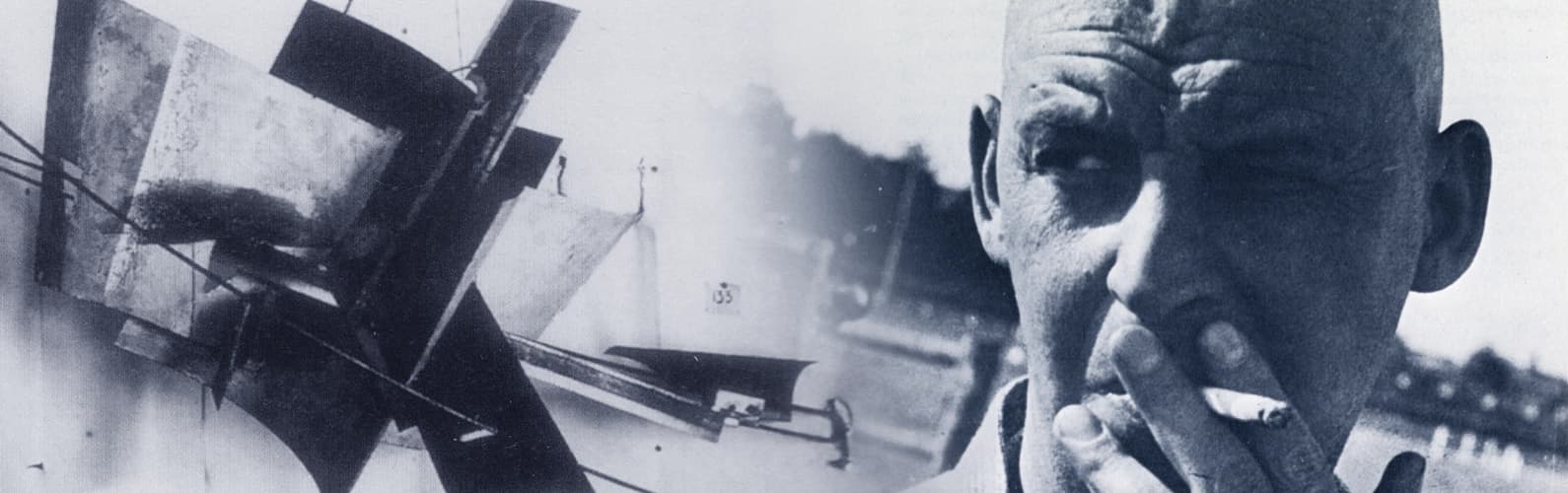
Constructivism grew out of the Russian avant-garde around the 1917 Revolution. Vladimir Tatlin’s earlier experiments with materials and construction provided an important foundation for its ideas. As artists questioned the role of art in a changing society, they moved toward production and practical design. The movement soon reached graphic design and other forms of visual and applied work, changing what an artist could make and where that work could exist.
Key Principles of Constructivism
Construction Over Composition
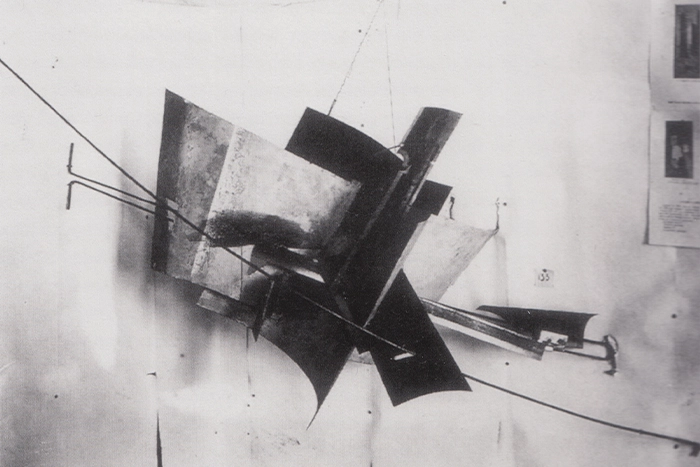
Constructivists approached art as something to be built. Forms and materials became parts of a constructed whole. Rodchenko took this idea literally in his spatial constructions.
Art Into Production
Constructivism moved art toward production. Artists turned to graphic design and other forms of practical work. They saw artistic work as something that could become part of everyday life.
Materials as Structure
Constructivists treated materials as an essential part of the work. They explored the physical qualities of materials, allowing those properties to shape the construction itself.
Design for Mass Communication
Constructivists embraced graphic design as a form of mass communication. Typography and photography became active parts of the composition. Photomontage made images easier to reproduce and distribute at scale.
Notable Designers
Vladimir Tatlin
Tatlin’s early constructions helped lay the foundations for Constructivism. His Counter-Reliefs explored the physical properties of materials. His unbuilt Monument to the Third International became one of the movement’s best-known symbols.
Alexander Rodchenko
Rodchenko was one of Constructivism’s central figures. His Books! poster showed how photography and typography could serve graphic communication. His work for LEF pushed photomontage into new territory.
El Lissitzky
Lissitzky brought Constructivist ideas into graphic design. His Proun series explored the space between painting and architecture. The Isms of Art offered a striking example of his experimental approach to book design.
Liubov Popova
Popova brought Constructivist ideas into practical design. Her stage sets for Vsevolod Meyerhold’s The Magnanimous Cuckold showed how geometric abstraction could shape a theatrical environment. She carried similar ideas into textile design.
Varvara Stepanova
Stepanova applied Constructivist ideas to textile design and clothing. Her Sporting Clothes designs turned geometric forms into functional garments. She also developed textile patterns for industrial production.
Georgii and Vladimir Stenberg
The Stenberg Brothers were major figures in Constructivist poster design. Their poster for Dziga Vertov’s The Man with the Movie Camera combined photography with bold typography to create a dynamic composition.
Historical Context and Influences
Constructivism grew out of the Russian avant-garde of the 1910s and early 1920s. Vladimir Tatlin’s constructions provided an important starting point, alongside the influence of Cubism and Futurism. Debates at Moscow’s Institute of Artistic Culture in 1920 and 1921 helped establish construction as a new approach to art.
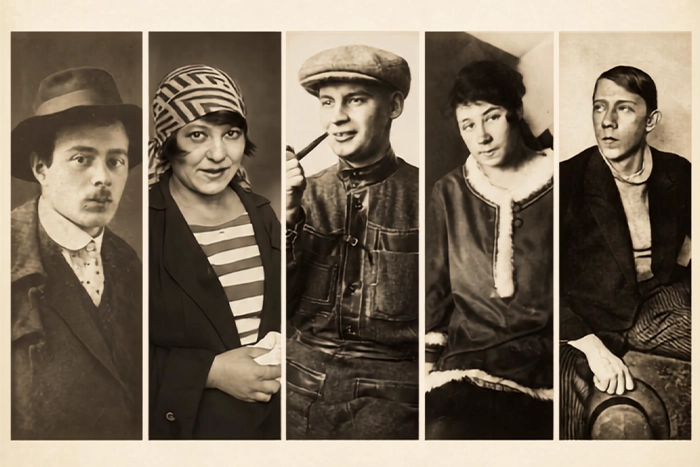
A major turning point came with the 1921 exhibition 5 × 5 = 25. Alexander Rodchenko, Liubov Popova, Varvara Stepanova, Alexandra Exter, and Aleksandr Vesnin each contributed five works. The exhibition signaled the growing shift toward production as artists moved beyond traditional easel painting. Constructivist ideas soon entered graphic design, theatre, textiles, photography, and other areas of practical work.
Constructivism also reached audiences beyond Russia. El Lissitzky helped bring its ideas into wider European modernism through his work in Germany. His contacts with the Bauhaus helped connect Constructivism with the broader development of modernist design.

Impact Today
Constructivism still informs the way designers combine type and image. Its influence can be felt in editorial and exhibition design. It also helped establish design as a practical activity with a public role, giving visual communication a more direct place in everyday life.
Short Answers (FAQ)
What is Constructivism in simple terms?
Constructivism was a Russian avant-garde movement that connected art with production and everyday life, especially during the 1920s.
What are the main characteristics of Constructivism?
Constructivism is associated with geometric form, bold typography, photomontage, and an emphasis on function.
Who were the key figures of Constructivism?
Key figures included Vladimir Tatlin, Alexander Rodchenko, El Lissitzky, Liubov Popova, Varvara Stepanova, and the Stenberg Brothers.