Home
Home Articles
 Twos Talks
 Videos
First Things First: The First Designed Book in History
A short essay on the origins of book design, from ancient manuscripts to Gutenberg's printed books.
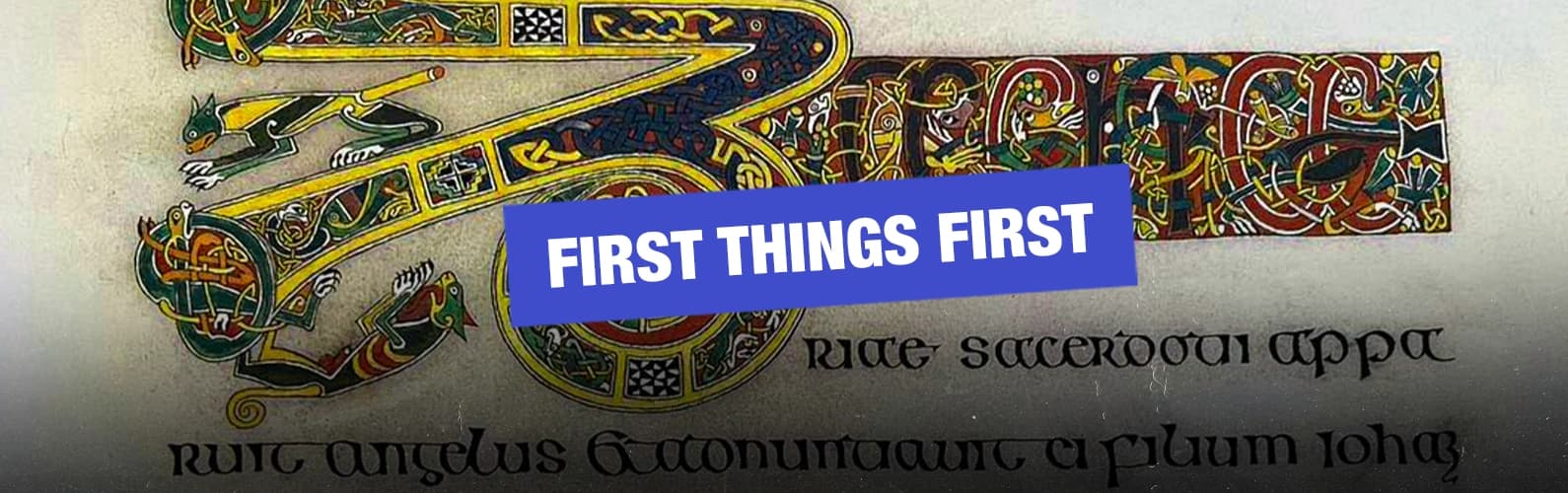
Today, we rarely question the design of a book. We open it and everything feels resolved. Margins frame the text, chapters begin in predictable places, images sit within a quiet architecture of space. The page appears natural, even inevitable. But it was not always this way. For most of human history, texts existed without what we would now call design. There were writings without pages, bound volumes without standardized layouts, and manuscripts without a consistent visual system.
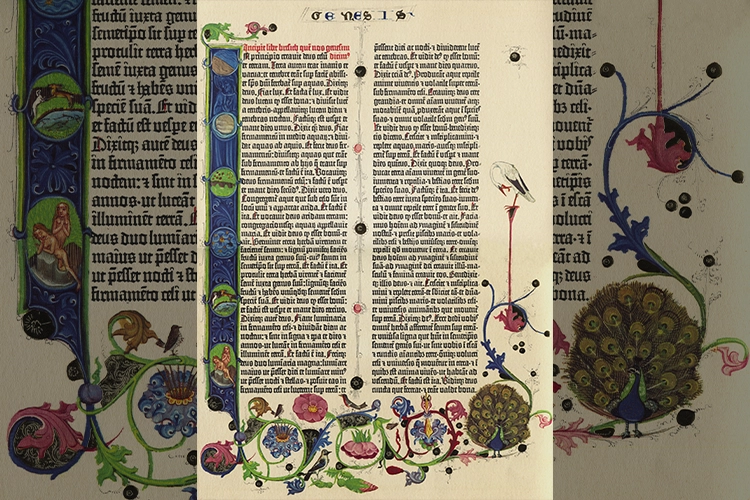
So, what was the first book design? The Gutenberg Bible (c. 1455) is generally considered the first book to embody modern book design because it combines consistent typography, repeatable page layout, and reproducible printing. Earlier manuscripts such as the Lindisfarne Gospels and the Book of Kells demonstrate sophisticated page design, but each remains a unique handcrafted work rather than part of a repeatable production system.
Yet the answer depends on how we define "book design."
What Do We Mean by "Book Design"?
Today, the phrase book design suggests a coordinated set of decisions. Type, layout, spacing, rhythm, and visual order work together to form a coherent object. A designed book is not only a container of text but a system whose pages behave consistently and whose structure repeats across the whole volume.
This definition is relatively modern. It grows out of print culture, typographic standards, proportional margins, and the expectation that pages follow a predictable structure. If we apply it to earlier periods, a problem appears immediately: most early texts do not meet these conditions.
Before we can search for a "first" example, we need to identify the basic components that make book design possible. At minimum, a designed book requires:
Pages: discrete surfaces that can repeat a visual structure
Layout: a predictable organization of text and space
Typography or lettering: deliberate form, not just handwriting
Reproducibility: a way for visual decisions to persist beyond a single copy
Without these elements, we may have writing, manuscripts, or decorated texts, but not book design in the sense we use the term today.
Before the Book
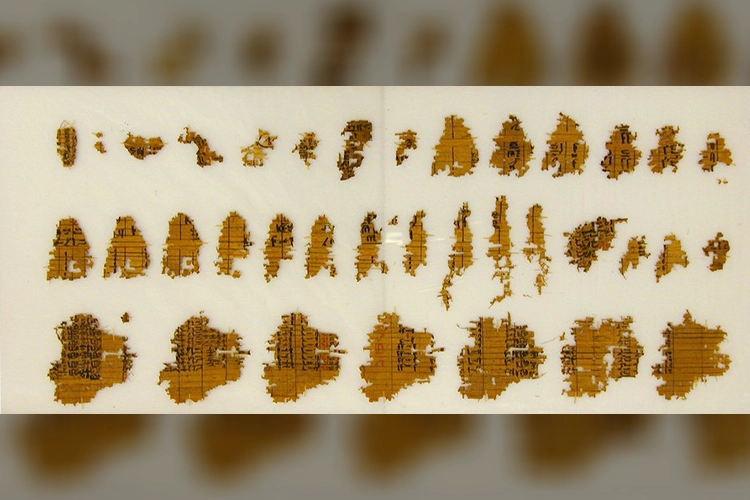
For much of human history, texts lived on continuous surfaces: clay tablets, wooden boards, papyrus rolls, and parchment scrolls. These materials carried writing, but they did not offer what we would now recognize as a page. A scroll unrolled in one direction. A tablet stood alone. There were no repeated surfaces and no stable unit for organizing space.
In ancient Mesopotamia, for example, cuneiform records were impressed on individual clay tablets, each one a self-contained object rather than part of a sequence of pages. In Egypt and later in the Greek and Roman worlds, long papyrus rolls carried literary and administrative texts across a single unfolding surface.
Even when scrolls were carefully written or decorated, their structure remained linear. The reader followed the text as the material allowed. Writing existed, but without discrete pages the idea of organizing text into a consistent visual system could not fully develop. The scroll delivered content. The book, as a space where design decisions could repeat and accumulate, had yet to appear.
When Pages Arrive
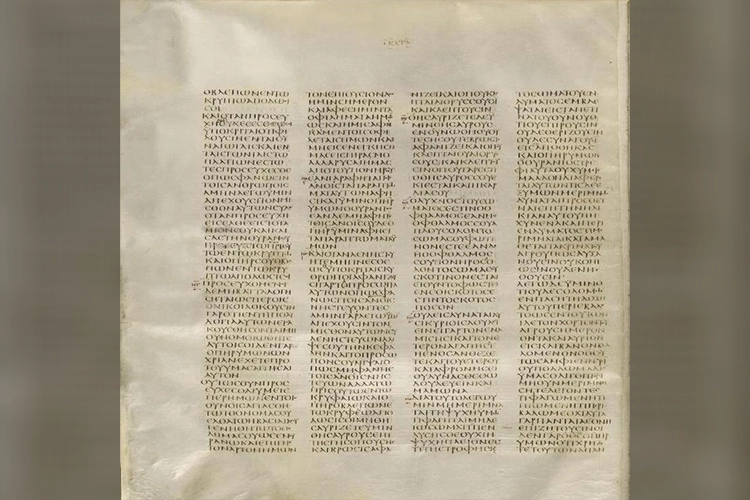
During the first centuries of the Common Era, a new format spread across the Mediterranean world: the codex. Sheets were folded, stacked, and bound along one edge, replacing the long roll with a compact object. Text no longer occupied a continuous surface but appeared on separate, repeatable pages.
Early Christian communities were among the first to adopt this format widely, copying scriptural texts into codices rather than onto scrolls. Long narratives were now divided into gatherings of leaves that could be opened at any point. A reader could move back and forth, compare passages across facing pages, and return easily to a marked place.
For the first time, text occupied a stable field. A page had edges and margins, a center and a boundary. Early codices were often dense and irregular, shaped more by economy than refinement. Yet once a surface repeats, patterns can form. With repeatable pages came the possibility of consistent layout and visual rhythm. The architecture of the book had begun to take shape.
Manuscript Culture
By the early medieval period, the codex had become the dominant form across much of Europe and the Near East. Scribes worked page by page. Each surface had to be prepared, pricked, and ruled before writing began, encouraging planning in advance.
In monastic scriptoria from Ireland to the eastern Mediterranean, pages were carefully ruled so that lines of text would sit evenly within intended margins. Line counts were estimated. Letter size was adjusted to maintain steadiness from one leaf to the next. Space was no longer incidental. It was arranged.
Decoration reinforced this structure. Enlarged initials, color, and ornament marked beginnings and transitions. In manuscripts such as the Lindisfarne Gospels (c. 700 CE) and the Book of Kells (c. 800 CE), the relationship between writing, margin, and image reveals deliberate page planning rather than spontaneous filling.
Each manuscript remained a unique object shaped by a particular scribe or workshop. Still, the habits of planning, organizing, and repeating visual decisions were firmly in place. Many of the principles later associated with book design were already present, though not yet stabilized across multiple copies.
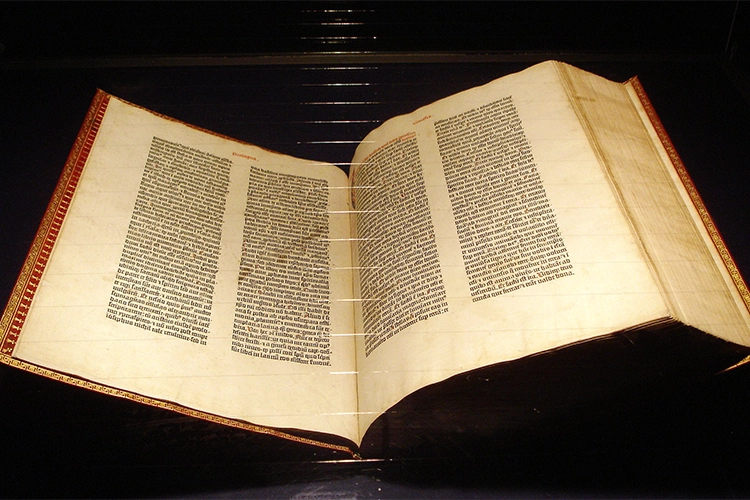
Photo courtesy of Antonio Zugaldia / Wikimedia Commons (CC BY 2.0)
Gutenberg's Bible and Reproducible Design
Printing in mid-fifteenth-century Europe transformed bookmaking. Manuscripts required careful planning, but printing required visual decisions that could be repeated consistently across hundreds of copies.
Movable type standardized letterforms, spacing, line length, and page proportions before production even began. Layout shifted from a flexible craft to a reproducible system.
Gutenberg's forty-two-line Bible, produced in Mainz around 1455, marks this transition. Its textura type, double-column layout, and balanced proportions still reflect manuscript traditions, yet the overall page structure could now be reproduced with remarkable consistency.
Surviving copies show nearly identical pages across hundreds of leaves. Decoration and rubrication were often added by hand, but the underlying design remained stable from copy to copy. For the first time, the visual structure of a book could be planned once and reproduced many times.
So, What Was the First "Designed" Book?
If we look for a single object to call the first designed book, several candidates appear:
The Lindisfarne Gospels (c. 700 CE)
A manuscript in which writing, ornament, and image are carefully arranged across the page. The composition shows clear planning, but each page exists as a unique creation.
The Book of Kells (c. 800 CE)
An elaborate example of medieval page composition, where decoration and lettering are tightly organized. Yet every page remains the product of individual craftsmanship rather than a repeatable system.
The Gutenberg Bible (c. 1455)
The first major European book printed with movable type. Its consistent typography, measured proportions, and organized page structure introduce a visual system that could be reproduced across many copies, even while its aesthetic language still echoed medieval manuscripts.
Rather than emerging from a single invention, book design developed gradually over centuries. Medieval manuscripts established the principles of page planning and visual hierarchy, while printing made those principles repeatable. In that sense, the Gutenberg Bible represents less the beginning of book design than the moment it became a reproducible visual system.
Short Answers (FAQ)
What was the first designed book in history?
The Gutenberg Bible (c. 1455) is widely regarded as a turning point in book design because it combined consistent typography, repeatable page layout, and reproducible printing.
Did book design exist before printing?
Yes. Medieval manuscripts such as the Lindisfarne Gospels and the Book of Kells demonstrate sophisticated page planning, lettering, and visual hierarchy. Printing made these design decisions reproducible across many copies.
Why is the Gutenberg Bible considered so important to book design?
Because it transformed book design from an individual craft into a repeatable system. Its typography, layout, and page proportions could be reproduced consistently, establishing many of the principles that shaped printed books for centuries.