Home
Home Articles
 Twos Talks
 Videos
First Things First: The First Photograph in History
A short essay on Joseph Nicéphore Niépce, the birth of heliography, the first permanent photograph, and the origins of the first selfie in history.
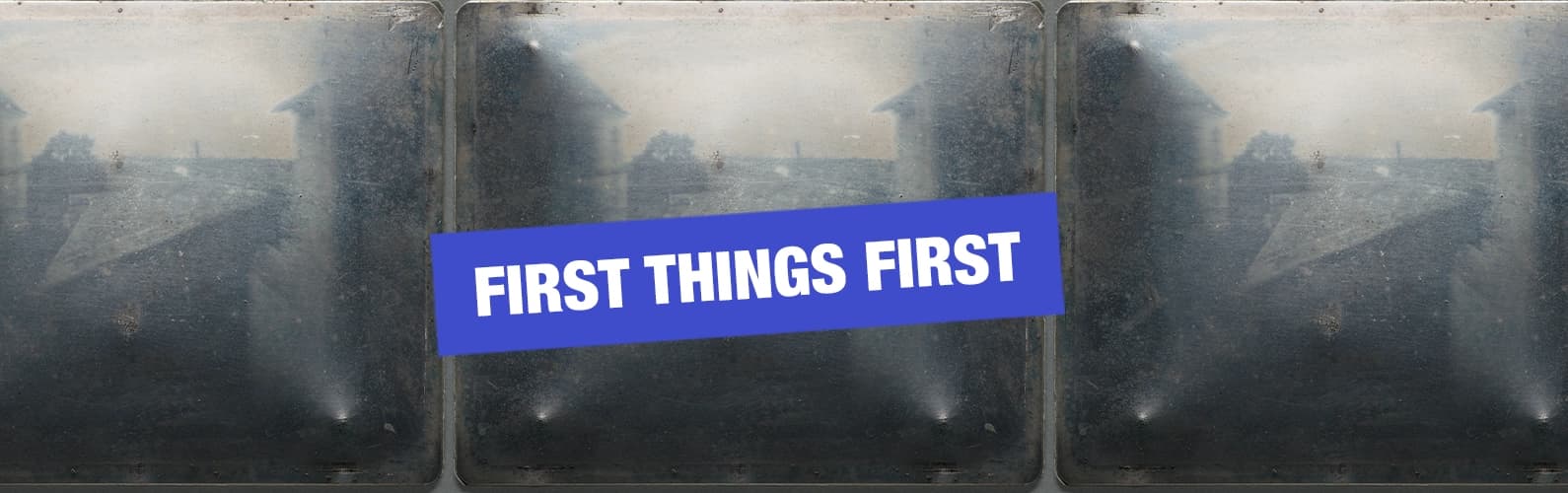
Before photography became a seamless and instantaneous part of our digital existence, capturing an image was an arduous labor of chemistry and time. For centuries, the camera obscura had allowed people to project light onto surfaces, but that light was fleeting. It could be traced by hand, but it could not be “fixed” because the image vanished the moment the light source moved.
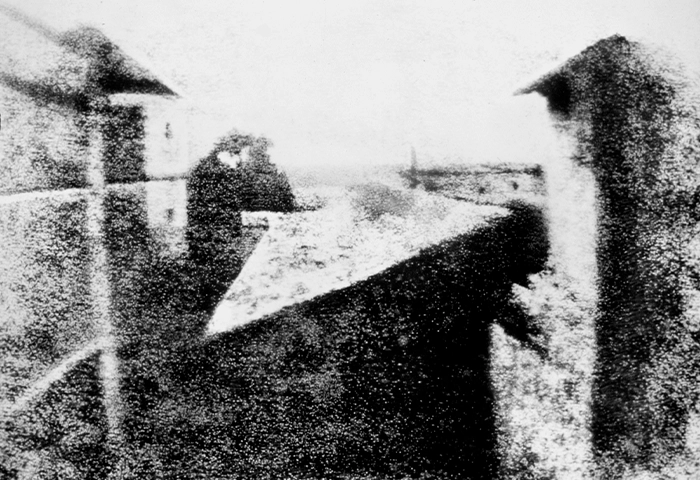
The first photograph in history, known as View from the Window at Le Gras, was captured in 1826 by the French inventor Joseph Nicéphore Niépce. It was not a portrait or a landscape in the modern sense, but a grainy and industrial-looking impression of a courtyard. It represents the precise moment recorded history shifted from the subjective hand of the illustrator to the objective “pencil of nature.” This essay explores the story of Niépce’s breakthrough and how a single plate of bitumen-coated pewter became the ancestor of every image we see today.
The Search for a Permanent Image
In the early nineteenth century, the world was visually documented through painting, sketching, and printmaking. The principles of optics were well-understood, and the challenge lay in chemistry. Scientists and inventors were searching for a substance that would not only react to light but would also stop reacting once the desired image was formed.
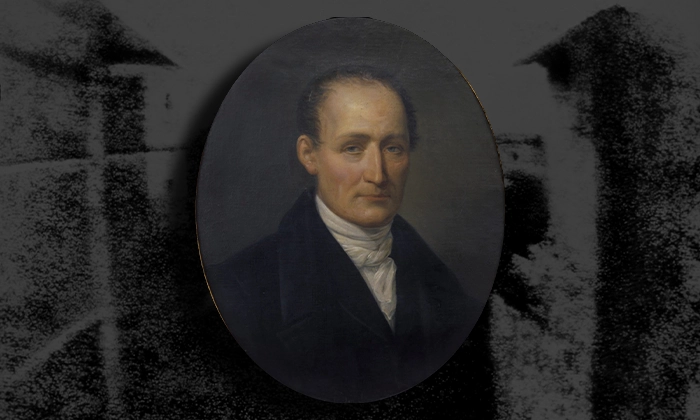
Joseph Nicéphore Niépce was not a trained artist, which perhaps fueled his desire to find a mechanical way to capture images. He began experimenting with various light-sensitive materials and eventually turned to bitumen of Judea, which is a naturally occurring asphalt that hardens when exposed to light. Niépce coated a metal plate with this substance and placed it inside a camera obscura. He hoped to let the sun do the work of the engraver.
View from the Window at Le Gras
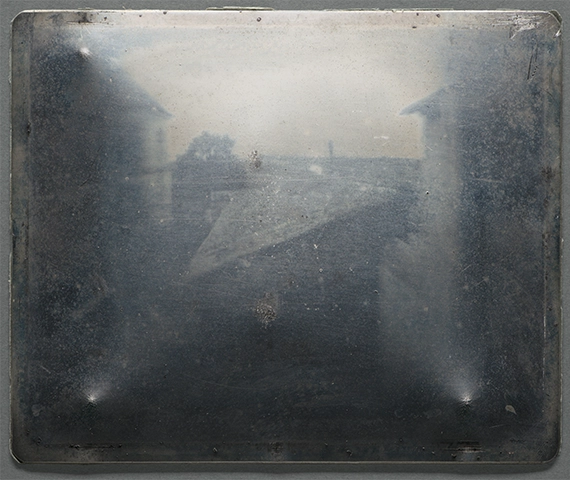
Historians generally agree that the first successful and permanent photograph was taken by Niépce in either 1826 or 1827. The image depicts the buildings and the surrounding countryside of his family estate in Saint-Loup-de-Varennes, France.
The process, which Niépce named Heliography, required an extraordinary amount of patience. Because the bitumen was only slightly light-sensitive, the exposure time for this first photograph lasted at least eight hours and possibly as long as several days. This explains the unusual lighting in the image. The sun had enough time to move across the sky, which meant it illuminated both sides of the buildings at once. The result was a blurry and high-contrast impression, but it was undeniably a fixed record of reality.
From Heliography to the Daguerreotype
Niépce’s invention was a radical proof of concept, but it was far from practical. The faint images and impossible exposure times meant that photography, in its first form, could never capture life in motion. It was a silent, still, and incredibly slow medium.
Recognizing these limitations, Niépce entered into a partnership with Louis Daguerre, a French painter and physicist who was also obsessed with the chemistry of light. After Niépce died in 1833, Daguerre continued their experiments alone. He eventually discovered that silver-plated copper treated with iodine vapor could reduce exposure times from hours to mere minutes.
This breakthrough created the Daguerreotype. It was the first commercially viable photographic process and the moment photography stepped out of the private laboratory and into the public imagination. While Daguerre’s name often takes center stage in history books, his success was built entirely upon the grainy, bitumen-coated foundation laid at Le Gras.
The First Human Photographed and the First Selfie
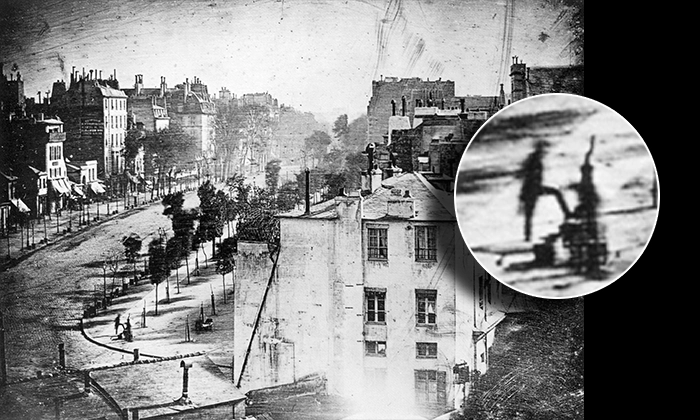
The evolution of photography didn’t stop at landscapes. In 1838, Louis Daguerre captured Boulevard du Temple, a busy Parisian street. Because the exposure lasted several minutes, the moving traffic disappeared, leaving only one visible soul: a man getting his shoes shined. He unknowingly became the first human being ever photographed.
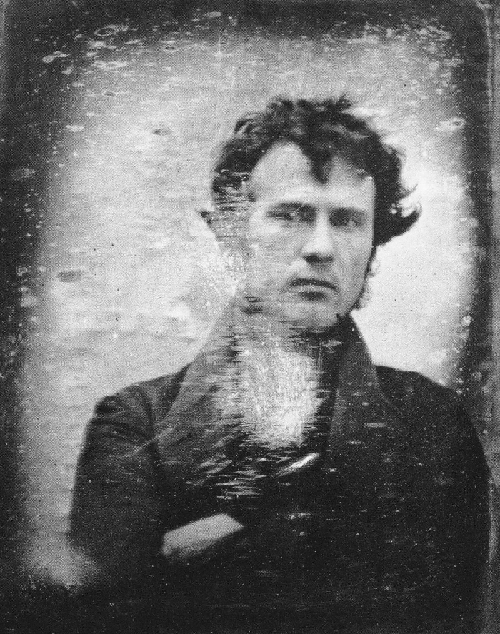
Shortly after, in 1839, an American photography pioneer named Robert Cornelius took the experiment further. He set up his camera in the back of his family’s silver shop in Philadelphia, ran into the frame, and sat still for over five minutes. The result was the world’s first self-portrait and, in a sense, the first “selfie” in history.
What Defines the “First” Photo?
Ultimately, the definition of the “first” photo depends on the criteria we use. If we define it as the moment light was first permanently trapped on a surface, Niépce’s 1826 plate is the undisputed origin.
While the technology has evolved from heavy bitumen plates to the pixels in our pockets, every digital image traces its lineage back to that single window in Le Gras. Through Niépce’s lens, the ephemeral finally became eternal. He provided the original blueprint for the visual culture of the modern age, proving that with enough patience, even the most fleeting light can be held forever.
Short Answers (FAQ)
What is the first photograph ever taken?
The first permanent photograph is titled View from the Window at Le Gras, captured by Joseph Nicéphore Niépce in 1826 or 1827 using a process he called heliography.
Who is the father of photography?
Joseph Nicéphore Niépce and Louis Daguerre are considered the founding figures of photography. Niépce captured the first permanent image, while Daguerre developed the first commercially successful process known as the Daguerreotype.
What was the first photo of a person?
The first photo to include a human was Louis Daguerre’s Boulevard du Temple (1838). A man getting his shoes shined remained still enough during the long exposure to be captured on the plate.
When was the first selfie taken?
The first self-portrait, or “selfie,” was taken in 1839 by Robert Cornelius, an American pioneer who sat for over five minutes in front of a camera in Philadelphia.