Home
Home Articles
 Twos Talks
 Videos
The Wildest Nightclub in Art History
In the middle of World War I, a small Zurich cabaret brought artists together for wild nights of poetry, performance, lectures, and visual experimentation. And then an art movement was born.
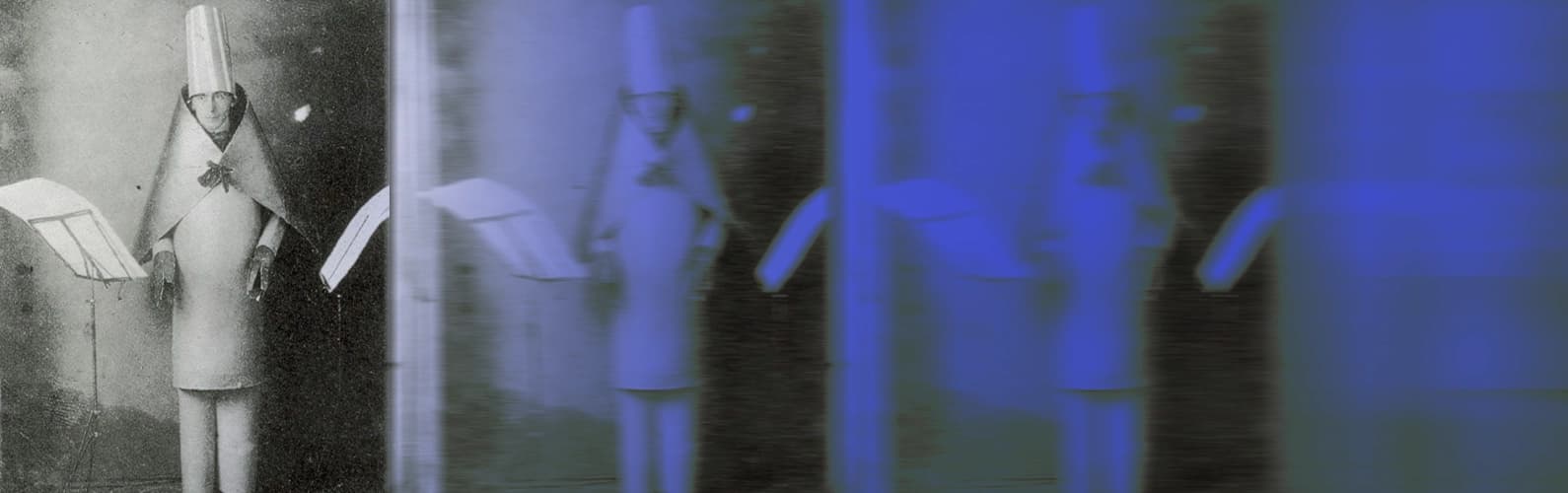
In 1916, while World War I was tearing Europe apart, a tiny cabaret opened inside a tavern in Zurich. Its nights were filled with strange costumes, experimental music, absurd poems, dances, lectures, masks, and performances that seemed to ignore every rule of respectable entertainment.
The place was called Cabaret Voltaire. Hugo Ball and Emmy Hennings had imagined it as a gathering place for artists, poets, and performers. Within months, a group of restless young creatives had gathered around the little room, and something new began to take shape. They would call it Dada.
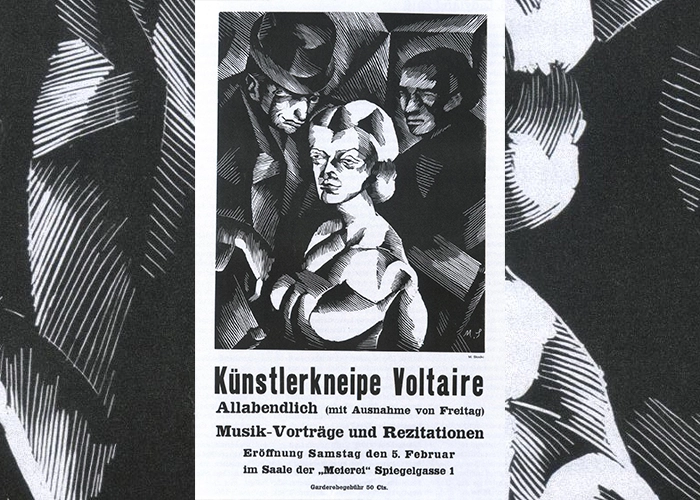
A Cabaret in the Middle of a War
In February 1916, Hugo Ball and Emmy Hennings opened Cabaret Voltaire in a small back room at the Holländische Meierei, a beer and wine tavern in Zurich’s old town. The venue stood at Spiegelgasse 1, a narrow street in the city’s Niederdorf district. The room had a small wooden stage and a piano and could hold around 50 people. Ball wanted a place where artists could meet and perform at a time when much of Europe was consumed by war.
Zurich had become a refuge for artists and intellectuals who had left countries caught up in the conflict. Ball and Hennings were part of this wider émigré scene, a community of people living away from their home countries amid the war. They soon drew other artists into the cabaret, including the Romanian poet Tristan Tzara, the Romanian artist Marcel Janco, the Alsatian artist Hans Arp, and the German writer Richard Huelsenbeck. Their backgrounds were different, yet they found themselves in the same small room in Zurich.
The original idea was simple. Ball invited artists to contribute to a program of evenings at the cabaret, and an invitation went out to young artists in Zurich without asking them to follow any particular artistic style.
The cabaret took its name from the Enlightenment writer Voltaire. Ball imagined it as a modern-day Candide, a satirical response to the optimism and complacency he saw around him as the war continued.
The room was small. The program was open-ended. And the nights at Cabaret Voltaire were about to become something far stranger.
What Happened at Cabaret Voltaire?
The answer is difficult to summarize because almost anything could happen on its tiny stage. Poems were performed in several languages. Music, dance, masks, stage sets, and visual art could become part of the same performance. Artworks hung on the walls, including works by Picasso, and the audience sat at tables beneath blue walls and a black ceiling.
In late May 1916, Hugo Ball staged a strange version of Silent Night. The performance barely used words. Instead, the room filled with snorts, an ocarina, a foghorn, cymbals, a whip, pans, and strange sounds from the performers. Marcel Janco controlled the lighting. Emmy Hennings sang a lullaby. Hans Arp made the sound of a sheep. Tristan Tzara cracked a whip. Ball called the piece bruitist, a term he used for his experiments with sound.
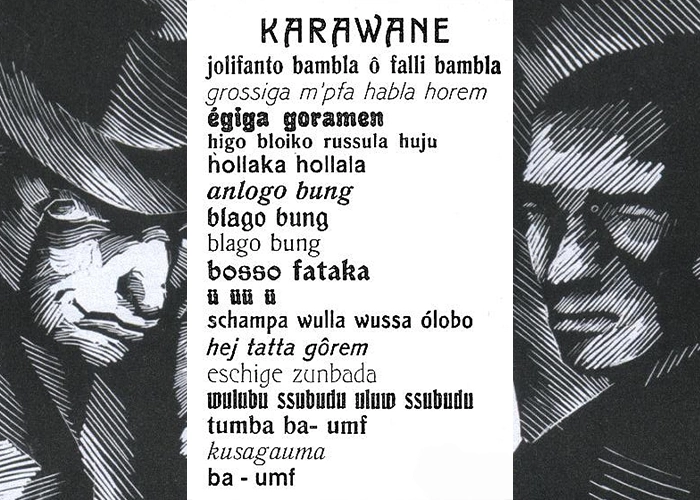
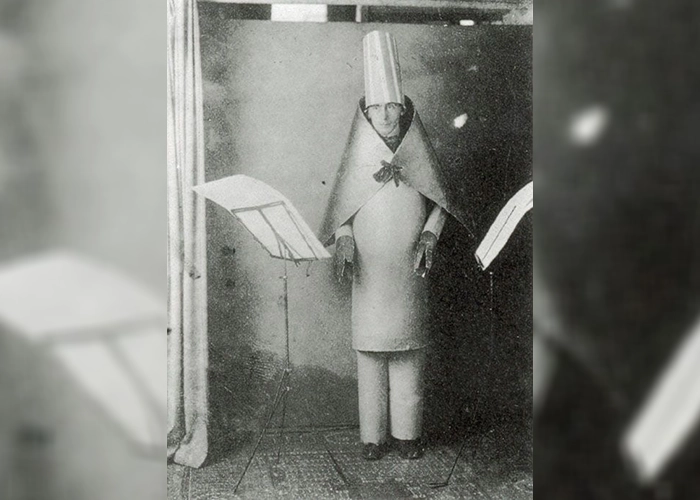
Then came Ball’s sound poems. On June 23, 1916, he appeared onstage in a Cubist costume and a cylindrical hat, looking like a strange magical bishop. He performed three sound poems, including Karawane, using invented sounds and syllables instead of conventional verse. The performance pushed language away from ordinary meaning and toward pure sound. By the end, Ball was carried from the stage in his costume. The image would become inseparable from the story of Cabaret Voltaire.
The Artists Behind the Chaos
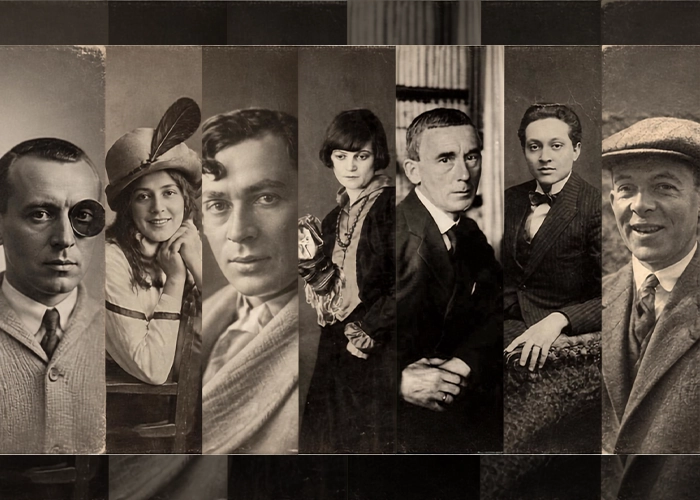
Hugo Ball — One of the founders of Cabaret Voltaire and its main organizer. A writer and performer who pushed language toward pure sound with works such as Karawane.
Emmy Hennings — Ball’s partner and co-founder, as well as a poet, singer, and performer. She was a central figure at the cabaret from its opening night and performed there regularly.
Marcel Janco — A Romanian artist and architect who gave the cabaret much of its visual character. He designed masks and costumes from materials such as cardboard and paper.
Sophie Taeuber — A Swiss artist and dancer who performed in Janco’s masks and costumes. She was a major figure of Zurich Dada, with important work in movement and abstraction.
Hans Arp — An Alsatian artist and poet who brought abstraction, collage, and poetry into the group’s experiments. He was one of Dada’s major visual artists.
Tristan Tzara — A young Romanian poet and one of the central figures of early Dada. His performances and writing helped carry the movement into the wider European avant-garde.
Richard Huelsenbeck — A German writer and performer who joined the group soon after the cabaret opened. He was an important voice in the early Zurich scene and later played a leading role in Berlin Dada.
When the Cabaret Became Dada
Cabaret Voltaire had opened without a manifesto or a movement in mind. The artists were still testing what they could do with poetry, performance, music, and visual art. Then, in April 1916, the group agreed on a name: Dada.
The origin of the word is still disputed. The famous story says it was found at random in a French dictionary. Other accounts connect it to the Romanian “da, da,” meaning “yes, yes.” Hugo Ball offered several playful meanings of his own. There was no single definition to settle the matter, and perhaps that was part of the appeal.
By late May, the word had made its way into print in Cabaret Voltaire, the group’s first publication. Ball edited the 32-page book, which featured texts, poems, and illustrations by artists connected to the cabaret. It was the first printed appearance of the name Dada and one of the earliest records of the group’s experiments.
Dada’s Visual Experiments
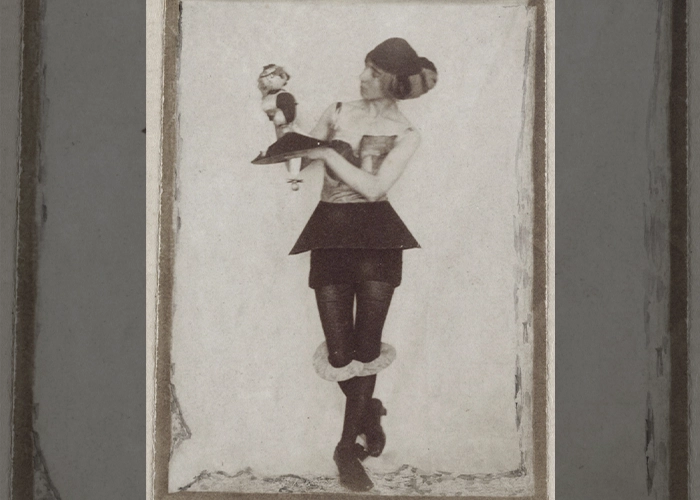
The visual side of Dada was already visible inside Cabaret Voltaire. Marcel Janco created masks for the performances from cardboard, paper, fabric, and other simple materials. The masks altered the performers’ appearance and gave the shows an unusual physical presence. Sophie Taeuber wore some of Janco’s masks onstage, and her dances added another dimension to the cabaret’s experiments with abstraction and performance.
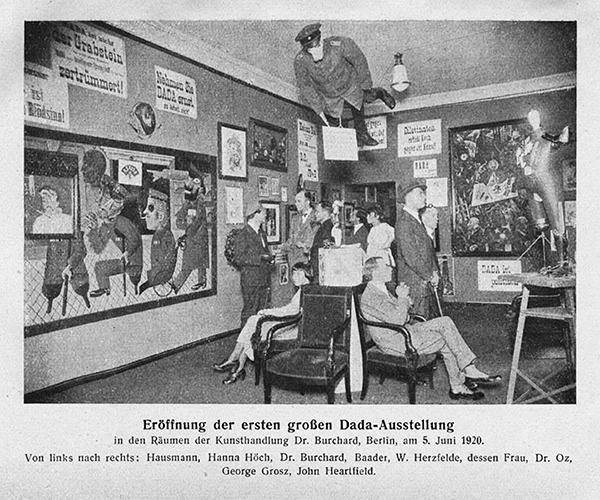
The experiments soon reached other Dada circles in Europe. In Berlin, artists began working extensively with printed photographs, newspaper clippings, and found images. Collage offered them a way to play with the visual language of mass media.
One of the key figures of Berlin Dada was Hannah Höch, who joined the circle in 1917 after meeting Raoul Hausmann. She was one of the early pioneers of photomontage. She cut photographs and printed material into pieces and assembled them into unexpected compositions. Her images frequently addressed questions of gender and the culture of the Weimar Republic.
Berlin Dadaists developed their own visual language, with photomontage at its center. They used fragments of contemporary newspapers and magazines to comment on the culture around them. The result was a distinctly modern form of Dada, rooted in the rapidly changing world of mass media.
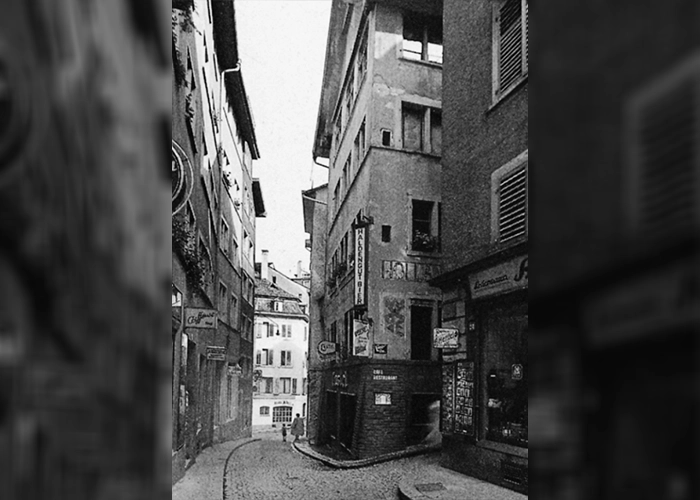
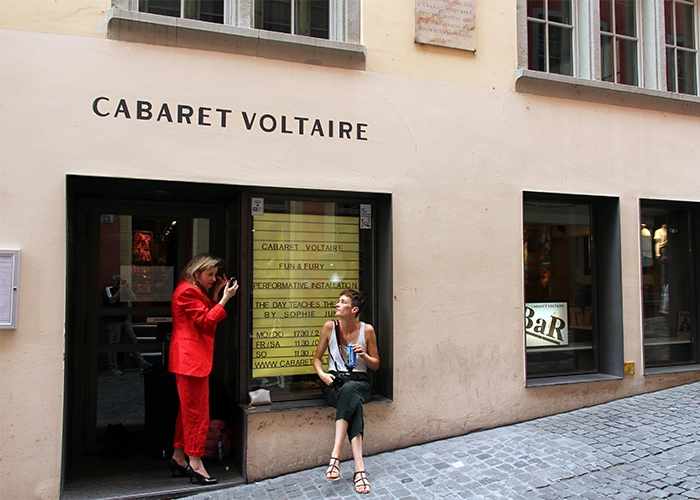
Photo: Fred Romero. CC BY 2.0.
The Night the Party Ended
On June 23, 1916, Hugo Ball gave his final performance at the cabaret. The regular program soon ended, and the last known event took place on July 6, 1916.
The artists who had gathered there went their separate ways, and Dada soon found new centers in cities such as Berlin, Paris, and New York. Cabaret Voltaire itself had lasted only a few months.
Its life was brief. Its experiments were anything but. The small room on Spiegelgasse soon entered the history of modern art, along with the name the artists had chosen for their strange new experiment: Dada.