Home
Home Articles
 Twos Talks
 Videos
Why Is Gen Z Suddenly Into Rothko?
How a painter who wanted his work to be experienced, not explained, became an icon of the image-saturated internet.
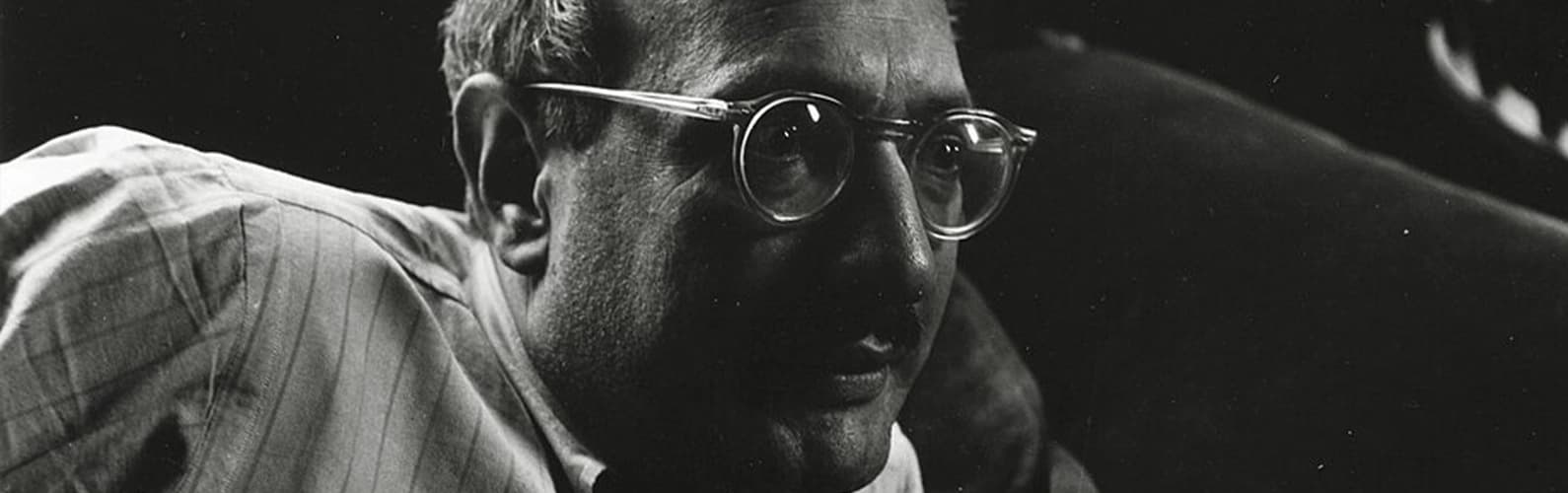
Ask a lot of Gen Z who their favorite painter is, and you might get an unexpected answer: Mark Rothko.
Not because Rothko has suddenly become the subject of a conventional art-world revival. He has been appearing somewhere much less predictable: TikTok and Instagram.
Some videos about his paintings are attracting hundreds of thousands of views. Young creators are styling outfits around individual Rothko paintings, assigning his works personality types, pairing his palettes with dream-pop, and even turning Rothko into a dating joke.
One young creator offers a simple explanation. Growing up surrounded by advertising, screens and constant visual stimulation, she says, has left her generation with “visual stimuli” that are already “at capacity.” Rothko feels different because, as she puts it, “Rothko doesn't tell you what to think.”
And yet there is something almost perfectly contradictory about the whole thing.
Rothko spent much of his career trying to make painting into something more than an image.
Gen Z is discovering him through one of the most image-saturated environments imaginable.
A painter who kept removing things
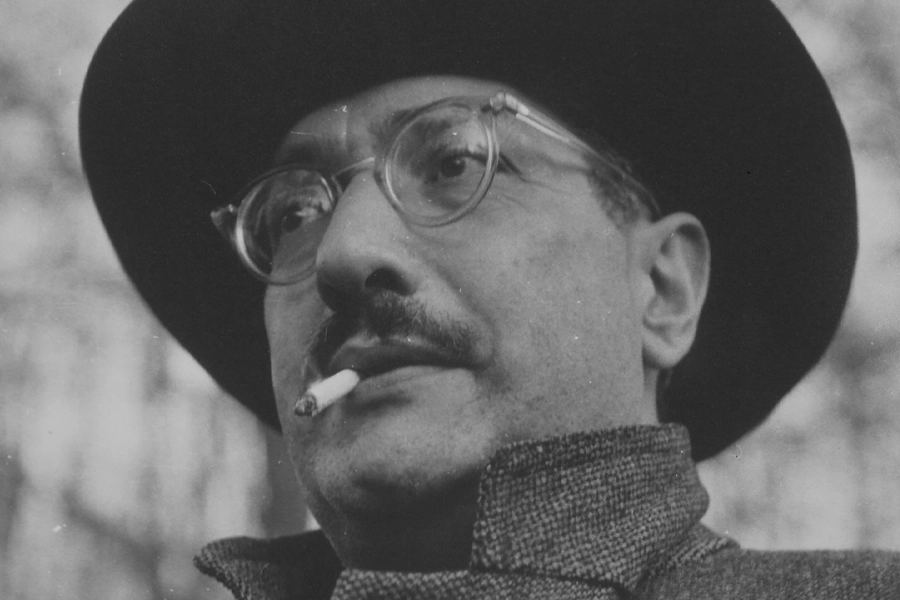
Mark Rothko was born Marcus Rothkowitz in Dvinsk, Russia, in 1903. His Jewish family immigrated to the United States when he was ten, and by the 1920s he had moved to New York and begun pursuing art. His early work looked nothing like the paintings for which he would become famous. He painted landscapes, city scenes, portraits and bathers before gradually moving toward a more subjective and abstract language.
By around 1949, Rothko had arrived at the format that would become his signature: large canvases containing soft-edged rectangles of color, floating vertically against fields of another color.
At first glance, the paintings seem almost aggressively simple. There are no characters to follow. No obvious event is taking place. There is usually no landscape, no object, no recognizable symbol. Nothing appears to be asking for interpretation in the conventional sense.
But that apparent simplicity was not the point. Rothko was interested in what painting could communicate after representation had been stripped away. He repeatedly described his subject in terms of “basic human emotions”: tragedy, ecstasy, doom. He believed abstraction could bypass the need to depict something recognizable and reach something more direct.
For Rothko, the rectangles were less about what they represented than what they made the viewer feel.
Why Rothko Wanted You 18 Inches Away
Rothko cared intensely about how, and where, his paintings were seen.
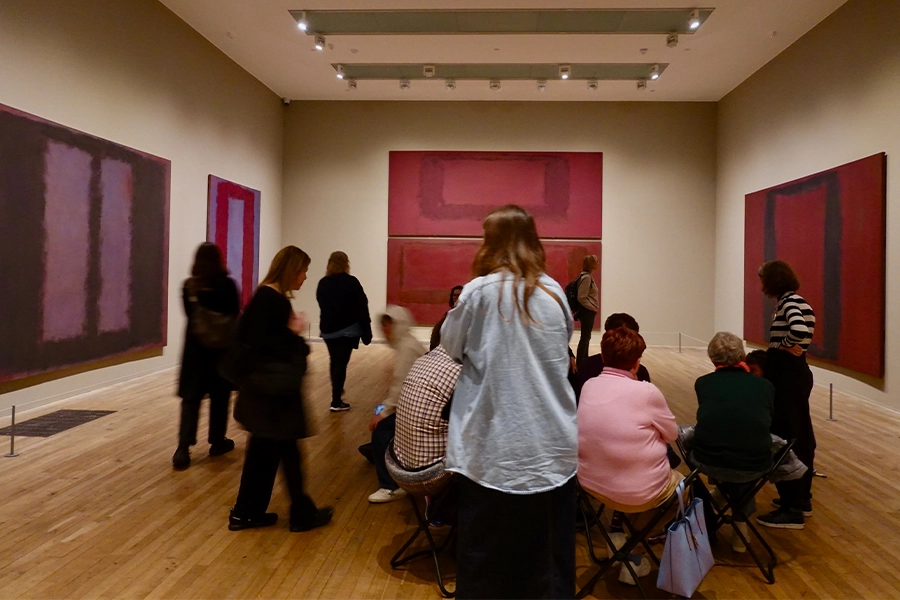
The Whitney notes that he wanted viewers to stand roughly 18 inches from some of his canvases, close enough to be enveloped by the painting and lose sight of the surrounding room. Standing close to the canvas changed the experience. The painting began to fill the viewer’s field of vision, creating a sense of solitude and immersion.
For Rothko, the experience mattered more than an explanation of what the painting meant. He compared painting to music, which can move you without telling you exactly what to feel. He wanted the viewer to step outside the ordinary world for a moment and experience the painting on its own terms.
That is also what makes his work difficult to reproduce on a phone screen. A photograph gives you the rectangles. It cannot quite give you the scale, the surface, the surrounding space, or the physical effect of standing inches away from several square meters of slowly shifting color.
And yet the phone is where a new generation is finding him.
Rothko versus the Fancy New York Restaurant
There may be no better story for understanding what Rothko thought a painting was for than the one involving a restaurant.
In 1958, Rothko accepted a commission to produce murals for the Four Seasons restaurant in New York’s Seagram Building. It was an extremely prestigious project, and the commission was worth $35,000. Rothko spent more than a year working on it and produced more than thirty canvases, even though the restaurant could accommodate only seven.
The paintings were dark, severe and unlike the luminous color fields with which he is most closely associated. Rothko was already thinking about them as something more than decoration. He wanted to create an environment, not simply a collection of pictures hanging on a wall.
Then he ate at the restaurant. The experience changed his mind.
Rothko became increasingly convinced that his work would be reduced to luxury décor for wealthy diners. He withdrew from the commission and returned the $35,000. The National Gallery of Art records his blunt explanation:
“Anybody who will eat that kind of food for that kind of prices will never look at a painting of mine.”
The murals did not disappear. Nine of the works from the project were eventually given to Tate, where they could be shown in a quiet, dedicated setting rather than as decoration for a dining room.
It is a strange detail in Rothko’s story: he had been paid to make art for an elite room and decided that the room was the problem.
Then the feed found him
Now return to 2026. Rothko is being turned into something that, in his lifetime, he might have found difficult to recognize.
A palette becomes an outfit. A painting becomes a personality. A color combination becomes a mood. A Rothko becomes something you can put on your date-night itinerary, put behind a piece of music, or use as a visual shorthand for how you feel.
One TikTok creator has begun building outfits around individual Rothko paintings, translating his color fields into clothes. Another assigns Rothko works personality archetypes, describing Untitled (Yellow and Blue) as a match for someone who “wakes up early, drinks citrus water and has their life together.” Elsewhere, users have paired his atmospheric palettes with the hazy melancholy of the Cocteau Twins. One creator even suggested a date with Rothko, provided nobody says, “I could have done these.”
This is part of what makes the current phenomenon more interesting than a simple “Gen Z discovers modern art” story.
Young audiences are finding Rothko through the visual language they already use to make sense of culture, from aesthetics and mood to identity, fashion, music, and memes.
It does not say: look here.
It does not say: buy this.
It does not even necessarily say: this is what it means.
It simply sits there.
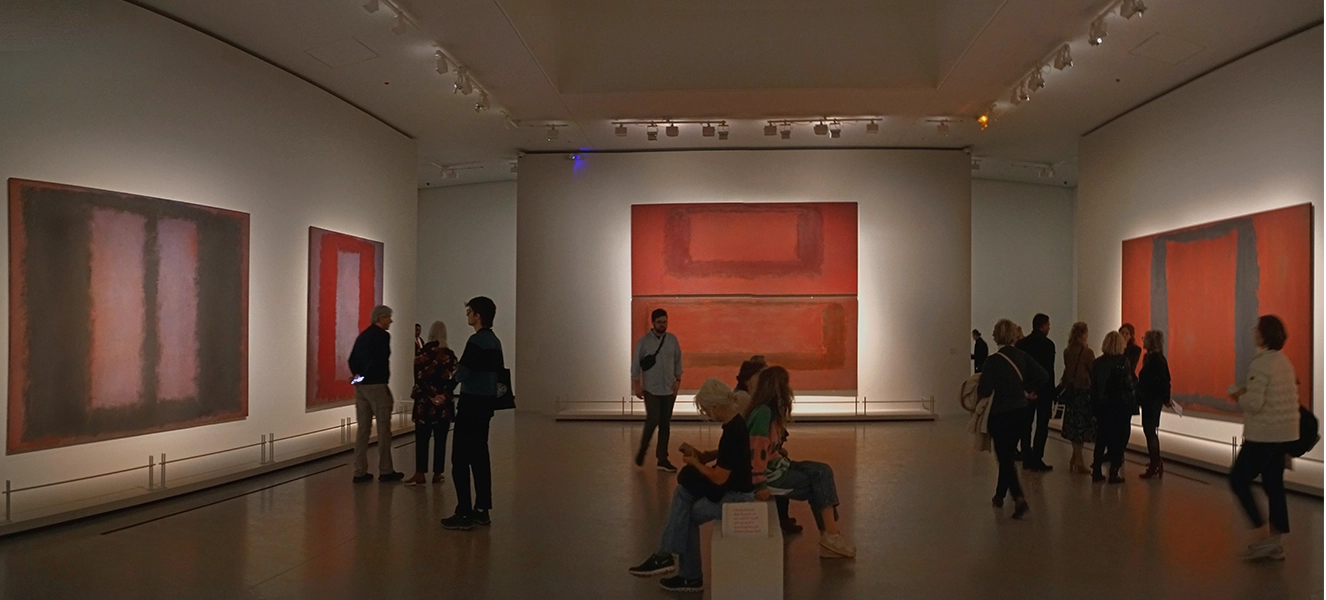
The most visual generation is looking for less
There is an obvious temptation to turn this into a neat generational diagnosis. Gen Z is overstimulated. Rothko is calming. Therefore, Gen Z loves Rothko. There may be something to that. But the story is more complicated.
Rothko’s paintings go beyond relaxation. They invite viewers to confront emotion, solitude, mortality, and transcendence. His work could be beautiful, but it could also be oppressive, unsettling or deeply sad.
And there is another danger in the way Rothko is discussed online: the image of the sad genius painting sad rectangles.
Rothko suffered from depression and serious physical and mental-health problems in the final years of his life, and he died by suicide in 1970. His late Black on Gray paintings have become closely associated with that biography. MoMA also places these works within a broader project in which Rothko used abstraction to explore universal truths about the human condition. His paintings extended beyond his own emotional state.
Reducing the paintings to “depressed man paints depressing squares” makes for an efficient internet explanation. It is also a much smaller idea than Rothko himself.
Rothko is everywhere in 2026
The social-media attention is happening at a moment when Rothko is also receiving serious institutional attention.
From March 14 through August 23, 2026, Florence’s Palazzo Strozzi is presenting one of the largest Rothko exhibitions ever mounted, with more than 70 works spanning his career. The project extends beyond the palace itself, placing Rothko’s paintings in dialogue with Fra Angelico at the Museo di San Marco and with Michelangelo’s architecture in the Laurentian Library.
His market has also remained enormous. On May 14, 2026, Brown and Blacks in Reds, a monumental 1957 Rothko, sold at Sotheby’s for $85.78 million, briefly making it the second-highest price ever paid for one of his works at auction. Four days later, Christie’s set a new record when No. 15 (Two Greens and Red Stripe) sold for $98.385 million.
So, there are now several Rothkos circulating at once.
There is Rothko the museum artist. Rothko the $98.4 million auction artist. Rothko the spiritual painter. Rothko the tragic biography. And Rothko the TikTok mood. They are not necessarily the same thing.
The Rothko problem
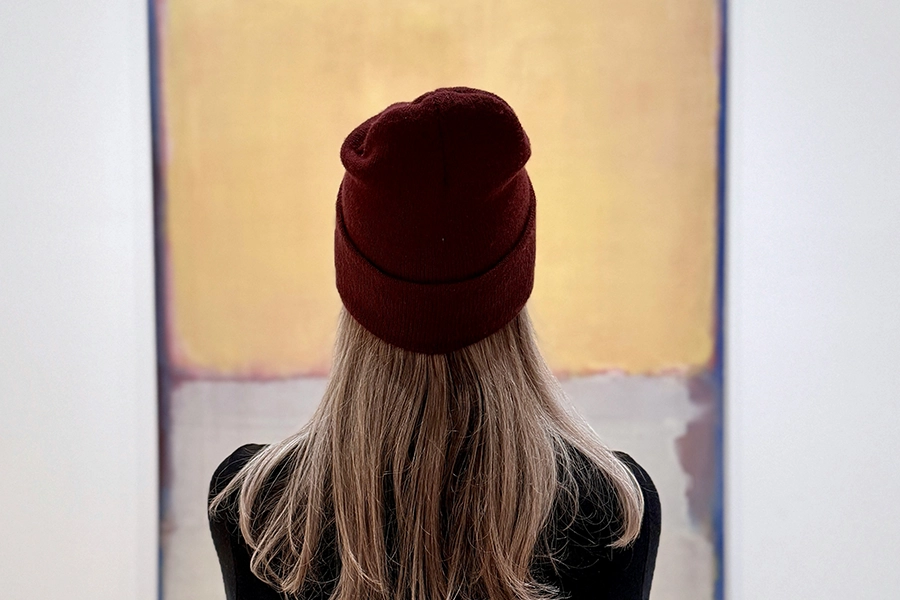
Perhaps this is what makes the current revival worth paying attention to. Rothko wanted to remove the distance between the painting and the person experiencing it. He wanted viewers to stop treating the work as an object to decode and experience it directly. For him, the painting became an encounter between the work and the person standing in front of it.
Social media has done almost the opposite. It has detached the paintings from their physical scale and architectural surroundings and turned them back into portable images.
A Rothko designed to engulf a viewer becomes a thumbnail. A painting intended to create visual solitude becomes content in an infinite feed. An artist who objected to decoration becomes an aesthetic. And yet something clearly survives the translation. People are still looking.
Perhaps that helps explain why Rothko keeps reappearing. Or perhaps the internet has simply found another visual language for talking about itself.
Either way, the question remains.
Rothko died in 1970, long before TikTok, Instagram, infinite scrolls or algorithms existed. He never had to see one of his paintings turned into a viral video, a fashion palette, a personality meme, or a $98.4 million auction headline.
What would Mark Rothko have thought of all this?
Would he have been pleased that so many people were still looking at his paintings?
Would he have objected to seeing them reduced to images on a screen?
And what would he have made of the fact that a generation discovering his work through TikTok or Instagram is still stopping to look at it?
Short Answers (FAQ)
Who was Mark Rothko?
Mark Rothko was an American painter best known for his large-scale color-field paintings, in which softly edged blocks of color explore emotions such as tragedy, ecstasy, and doom.
Why is Gen Z interested in Rothko?
Rothko has recently become popular on TikTok and Instagram, where young creators are turning his paintings into fashion, personality types, music references, and memes. Some creators say his open-ended paintings offer a break from the constant visual stimulation of social media.
Why are Rothko’s paintings so simple?
Rothko gradually stripped away recognizable subjects and narrative elements to explore what color, scale, space, and emotion could communicate on their own.