Home
Home Articles
 Twos Talks
 Videos
Stefan Sagmeister on Why Graphic Designers Should Open Their Own Studio
Stefan Sagmeister reveals how graphic designers can build meaningful, successful careers by prioritizing independence, personal authorship, and creative freedom over hierarchy.
Editor’s Note:
This article is adapted from our podcast interview with Stefan Sagmeister, originally recorded for Twos Talks and released on the Twos Studio YouTube channel. It has been edited for clarity and format.
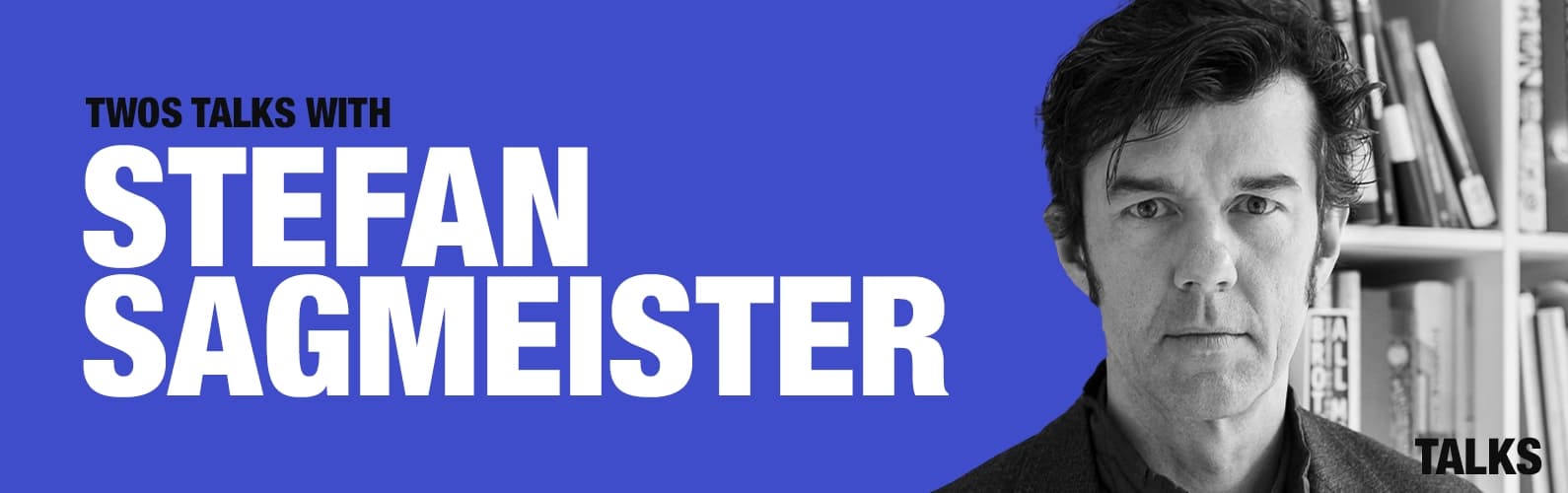
In this episode of Twos Talks, we speak with Stefan Sagmeister, a New York–based graphic designer known for his experimental approach to visual communication, his long-running independent studio practice, and his later role as co-founder of Sagmeister & Walsh. He shares why he chose to open his own studio, what responsibility means to him in a creative career, and why he believes designers should rely less on institutional protection and more on personal authorship. Sagmeister also explains why, in his experience, running a design studio is often simpler than it appears, drawing on decades of firsthand practice rather than theory.
Everything Is Your Fault
When asked how a designer can stand out individually in an environment layered with creative directors, strict guidelines, and multiple approvals, Sagmeister does not hesitate. We offered him three possibilities: focusing fully on the work at a studio or agency, developing personal side projects, or saving enough to open one’s own studio.
“Out of those three possibilities, I would definitely choose number three. Opening your studio.”
For Sagmeister, the difference is not only about creative freedom but about how responsibility is experienced. Running his own studio, he explains, removed ambiguity around decision-making.
“I was never happier than in my own studio. I would much rather make the mistake myself than feel somebody else made the mistake and I blame them.”
Inside large organizations, he recalls feeling frustrated not because of the work itself, but because decisions were ultimately out of his control. Clients were taken on for reasons he disagreed with, projects moved forward despite being poorly conceived, and resentment quietly built up.
“In my own studio, everything is my fault. If a client is awful, I took them on. It’s my fault. I’m much happier in that position.”
Learning What Not to Do, Fast
Before opening his studio in New York, Sagmeister worked at a large advertising agency in Hong Kong. It was his first job out of school, and the pace was extreme.
“We worked literally sixteen hours a day, including weekends, for long stretches of time.”
The environment was intense, but it offered rapid exposure to responsibility. Within weeks, he became a creative director. He experimented across disciplines, ran teams, and learned quickly what kind of work culture he personally did not want to repeat.
“It was a fantastic time to learn about all the things I never wanted to do again. Very quickly.”
Ironically, the workload also created an unexpected advantage. With little time to spend money, he returned to New York with enough savings to set up a studio with low monthly costs. That financial cushion made early independence possible.
“It allowed us to take on jobs mostly by how much we wanted to do them and not by how much they paid.”
Kalman and the Moment Sagmeister Opened His Studio
Sagmeister briefly worked at M & Co. under Tibor Kalman, a studio he deeply admired. But after having already run a studio in Hong Kong, returning to the role of senior designer felt limiting to him.
“I had been making all the decisions. Which client to work with. Who to hire. Going back to becoming another senior designer wasn’t that exciting.”
When Kalman moved to Rome to focus on Colors magazine, Sagmeister interpreted it as a clear signal.
“That really meant I have to open my own. It was the best thing that could happen to me.”
For him, independence was not a romantic gesture but a logical next step based on prior experience. He felt comfortable inside respected studios, but that comfort could not replace the satisfaction of ownership.

Why Running a Design Studio Is Easier Than You Think
Sagmeister is direct about the business side of graphic design, especially when comparing it to other industries.
“From a business perspective, a graphic design business is one of the easiest businesses to do because it needs almost no capital investment.”
No machinery, no inventory, no production lines. In his view, a computer is often enough. What matters more is basic structure and discipline.
“You need two little systems. One to know how much money you need for the business to work. And one to know where clients should come from.”
Everything else, he argues, is largely practical. Spend less than you earn. Know your costs. Understand what your clients actually need. This way of thinking also informed how he chose collaborators and partners.
“What made Jessica Walsh stand out was not just talent. It was common sense. She understood the business and how to translate what a client needed into a design that worked.”
Who You Want in a Studio Environment
When Sagmeister was hiring for commercial work, portfolios mattered, but personality mattered just as much to him.
“We wanted nice people. People you wanted to spend time with. Kind people who supported others.”
This belief was reinforced during his years teaching. The students who went on to build strong careers were not always the most visually talented.
“The students who made the biggest careers were the ones who were most helpful to other students.”
Helpfulness created trust, trust created support, and support opened doors. Not as a calculated strategy, but as a pattern Sagmeister repeatedly observed.
“Everybody wanted to have them around.”
Long-Term Thinking Over Short-Term Safety
Sagmeister repeatedly returns to the same idea. For him, creative satisfaction comes from ownership rather than protection. Running a studio, he argues, encourages accountability and long-term thinking.
“A small business that is not run well will make you lose money faster than sitting on a beach drinking margarita.”
The warning scared him early on, but it also made him more deliberate in his decisions. Independence, in his view, does not mean recklessness. It means understanding consequences and accepting them fully. For designers stuck inside layered hierarchies, Sagmeister’s advice is simple but demanding:
“Save. Learn. Take responsibility. Then step out. Not because it is easy, but because it is yours.”